Set 1: Command of Evidence
Explanation
PASSAGE
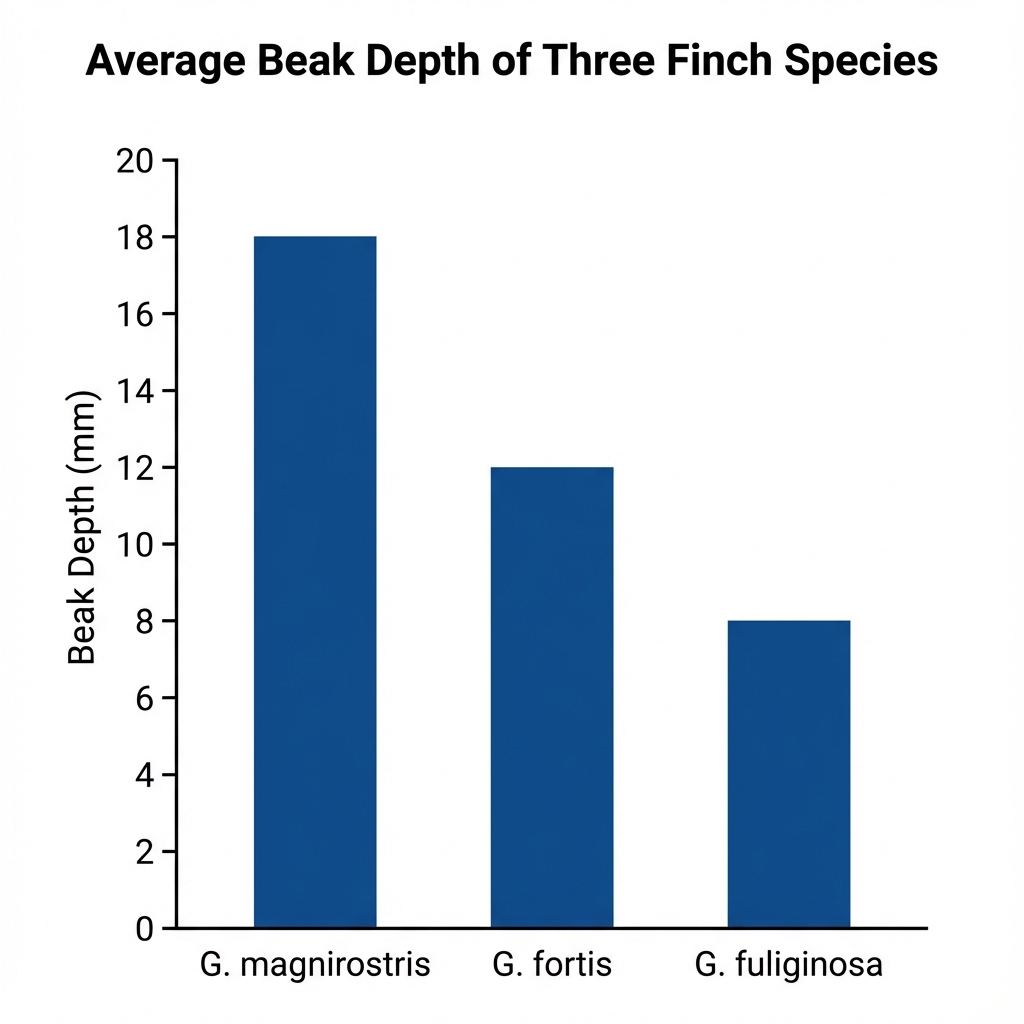
The graph displays the average beak depths of three distinct species of Darwin's finches found on the Galápagos Islands: *Geospiza magnirostris*, *Geospiza fortis*, and *Geospiza fuliginosa*. Beak depth is a significant trait that influences the types of seeds these birds can crack and eat.
Which statement is best supported by the data in the graph?
Detailed Explanation
This question requires you to identify evidence that supports a claim. The graph shows the bar for *G. magnirostris* is the highest, reaching approximately 18 mm, while *G. fortis* is around 12 mm and *G. fuliginosa* is around 8 mm. Therefore, *G. magnirostris* has the largest average beak depth. The best evidence directly and explicitly supports the stated claim without requiring assumptions. Match specific textual details or data points to the claim being made. The correct answer provides clear, direct support. Strong evidence directly addresses the claim without requiring additional interpretation. When evaluating options, look for quotes or data that explicitly support the statement. Weak evidence may be tangentially related but doesn't provide direct proof.
Key Evidence:
• "The graph displays the average beak depths of three distinct species of Darwin's finches found on the Galápagos Islands: *Geospiza magnirostris*, *Geo"
Why others are wrong: A (The bar for G. fuliginosa is shorter (lower value) than the bar for G. fortis.), C (The bar for G. fortis is around 12 mm, not 18 mm.), D (G. fortis and G. fuliginosa have beak depths well below 15 mm.).