Set 16: Exponential Functions (Advanced)
Explanation
An investment of $8,000 earns continuous compound interest at 5% annual rate. What is the value after 10 years?
Use: where
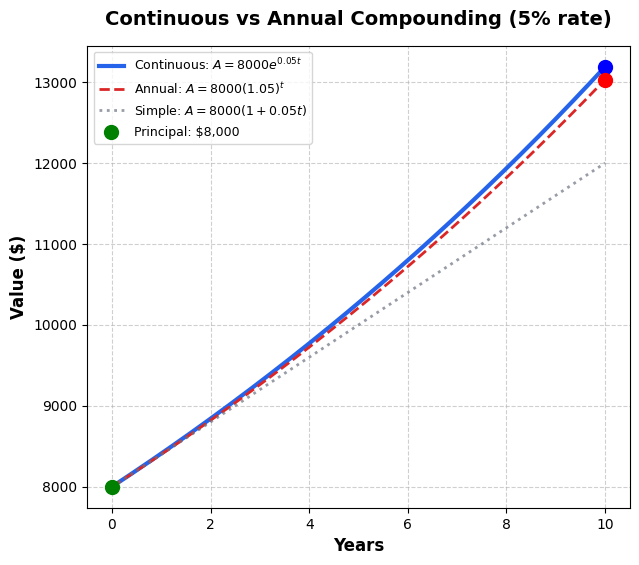
$13,181.23
$12,000.00
$14,000.00
$13,030.16
Detailed Explanation
Choice A is correct. Choice A is the correct answer. Apply the continuous compound interest formula. 1. Formula: where , , . 2. Calculate exponent: . 3. Compute: . 4. Result: After 10 years, the investment is worth $13,181.23. Strategic Tip: Continuous compounding uses base , which grows faster than annual compounding. Choice B is incorrect because this assumes simple interest (8000 + 4000). Choice C is incorrect because this calculation is wrong. Choice D is incorrect because this uses annual compounding, not continuous.
Key Steps:
The correct answer is $13,181.23
🎯 Keep Practicing!
Master all sections for your best SAT score